Court Cases
All Cases
47 Court Cases
Oct 20, 2026

ACLU Foundation v. ICE
The American Civil Liberties Union, ACLU of Virginia, and ACLU of North Carolina filed a lawsuit against Immigration and Customs Enforcement (ICE) to obtain records regarding the agency’s potential plans to expand immigration detention across Virginia. The lawsuit, filed in the U.S. District Court for the Southern District of New York, demands that ICE comply with the Freedom of Information Act and immediately turn over the requested records to the ACLU.
Jun 5, 2026
Asheville Blade v. City of Asheville
On December 25, 2021, Asheville police officers cleared an encampment of unhoused people and community activists in a city park. Two journalists, Melissa Coit and Matilda Bliss, were reporting on the situation for a local publication called The Asheville Blade. The police officers ordered everyone to clear the area and began threatening arrests. Coit and Bliss identified themselves to the officers as journalists and did not interfere with police operations, but the officers arrested them, charged them with trespassing, and held Bliss’s phone for 25 days without a warrant.
The ACLU of North Carolina filed a lawsuit on behalf of Coit and Bliss, arguing that the arrests violated their First Amendment rights and that the seizure of Bliss’s phone violated the Fourth Amendment and the Privacy Protection Act of 1980.
On October 17, 2025, the City filed a Motion to Dismiss. On May 13, 2026, the judge held a hearing on the Motion to Dismiss. The judge has not yet issued a decision.
Apr 24, 2026
State of North Carolina v. Ducker (amicus)
Eric James was convicted under North Carolina’s felon-in-possession statute, which categorically strips anyone with a felony conviction of their right to own or possess a firearm, regardless of how minor or nonviolent the underlying offense was, how long ago it happened, or whether the person poses any danger today.
Ducker challenged his conviction, arguing that applying this lifetime ban to him violated both the Second Amendment and the North Carolina Constitution. The Court of Appeals rejected his challenge without conducting an individualized analysis, concluding that all people with felony convictions are automatically excluded from Second Amendment protection.
The ACLU of NC and the Cato Institute filed a joint amicus brief urging the North Carolina Supreme Court to reverse that ruling. People do not lose their constitutional rights just because they have been convicted of a felony. The U.S. Supreme Court’s decisions in Bruen (2022) and Rahimi (2024) require courts to evaluate gun restrictions like the felon-in-possession statute on a case-by-case basis. North Carolina’s statute sweeps far too broadly, stripping people of their constitutional rights for offenses as minor as digging up a Venus flytrap or changing the mileage on a vehicle’s odometer. Violent crimes account for only 16.4% of all felony charges statewide, yet this statute applies to individuals convicted of nonviolent crimes in the same way as if they were convicted of first degree murder. The impact of the law falls particularly hard on rural and Black North Carolinians, who are disproportionately impacted by both felony convictions and the loss of firearm rights. Instead of keeping people safe, the law furthers the cycle of mass incarceration by sending people who have completed their sentences back to prison solely for exercising a constitutional right. We urge the Court to hold that the felon-in-possession statute cannot be constitutionally applied to people who pose no danger and to remand for an individualized constitutional review of Ducker’s conviction.
Apr 6, 2026
Durham County Youth Home Complaint
On December 12, 2025, the ACLU of North Carolina and the Duke Children’s Law Clinic filed a systemic state complaint with the Department of Public Instruction (DPI), alleging that Durham Public Schools denied legally required education services to students with disabilities detained at the Durham County Youth Home.
Youth homes house young people who are detained while their cases move through the juvenile legal system. Many of the youth in these facilities have identified disabilities requiring special education services.
The complaint alleges that Durham Public Schools failed to provide students with disabilities with the educational support and services to which they are legally entitled. Specifically, it raises concerns that beginning in February 2025, the Youth Home implemented a near-total suspension of educational services, including special education services, during a facility-wide lockdown. Students were reportedly confined to their cells between 22 and 24 hours per day and received education services for no more than 30 minutes at a time. Even after the lockdown was lifted, students reportedly continued to receive only minimal instruction.
In January 2026, DPI declined to investigate the complaint, stating that it contained “insufficient facts to support the alleged violation.” The ACLU of North Carolina and the Children’s Law Clinic refiled the complaint in February 2026 with additional evidence. On March 12, DPI announced that it will open an investigation into whether Durham Public Schools complied with federal and state laws governing special education services for students detained at the Youth Home. The agency has indicated that it expects to complete its investigation and issue a final report by April 25, 2026. If violations are found, DPI may require Durham Public Schools to take corrective action to bring the facility into compliance with special education law.
Mar 26, 2026
Disability Rights NC v. NC DHHS
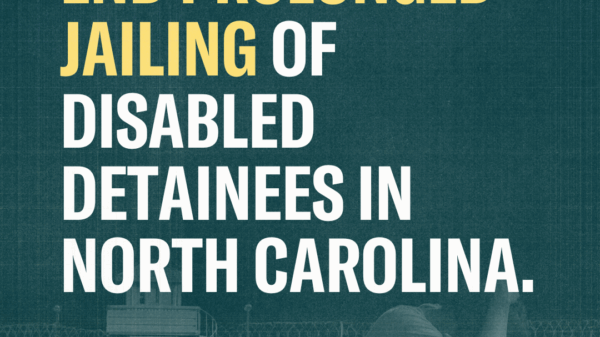
The North Carolina Department of Health and Human Services (NCDHHS) is violating the rights of disabled pre-trial detainees in NC jails by failing to ensure timely evaluations and treatment for people who lack capacity to understand the legal proceedings against them, according to a federal lawsuit.
Feb 9, 2026
Kwiatkowski v. Dismukes
The ACLU of North Carolina and Emancipate NC filed a lawsuit in February 2026 challenging a provision of House Bill 805 that functionally bans gender-affirming care for people who are incarcerated in North Carolina prisons or otherwise in the custody of the Department of Adult Corrections.
The lawsuit argues that this ban violates the Eighth Amendment, which requires states to provide medically necessary care to individuals in their custody. Failure to provide this care constitutes cruel and unusual punishment. The lawsuit also includes a class action claim to seek relief for people who are currently incarcerated and may be harmed by the new law.
Stay Informed
Sign up to be the first to hear about how to take action.
By completing this form, I agree to receive occasional emails per the terms of the ACLU’s privacy statement.
By completing this form, I agree to receive occasional emails per the terms of the ACLU’s privacy statement.