
NC NAACP v. Cooper (Rights of Incarcerated People)
- Filed: Apr 7, 2020
- Status: Active
- Court: Wake County Superior Court
- Latest Update: Feb 25, 2021
Summary
From the outset of the pandemic, public health experts sounded the alarm that without swift and drastic actions, prisons and jails across the country would see severe outbreaks of COVID-19. As cases of COVID-19 spread across the state, a coalition of organizations called for state officials to take action to protect incarcerated people, corrections employees, and the general public by reducing the use of imprisonment in North Carolina.
Letters were sent to Governor Roy Cooper and other state leaders asking them to take necessary steps including releasing people from jails and prisons who were not a threat to public safety, reducing the number of new people entering the system, and protecting the health of those who were incarcerated. The requests were in line with steps that had already been taken in several North Carolina localities and others across the country in recognition of the unique vulnerability of incarcerated people and correctional staff to the pandemic.
“People in prisons, jails, and detention centers are uniquely vulnerable in this moment of a public health emergency. People in confinement have no control over their own movement and are held in close quarters without adequate resources for hygiene, creating the perfect conditions for the dangerous spread of COVID-19,” said Chantal Stevens, Interim Executive Director of the ACLU of North Carolina. “It is essential that all government officials follow the recommendations from public health experts to stem the spread of the coronavirus in our communities by protecting the health and safety of incarcerated people, medical staff, and correctional officers.”
On April 8, 2020, the ACLU of North Carolina, Disability Rights North Carolina, Emancipate NC, Forward Justice, and the National Juvenile Justice Network filed a lawsuit in Superior Court to ensure that the Governor and other public officials would take further action to stop the deadly spread of COVID-19. The lawsuit sought an immediate order compelling officials to reduce the prison population in order to enable the social distancing that experts agreed was necessary to prevent the spread of the deadly virus.
Case Timeline:
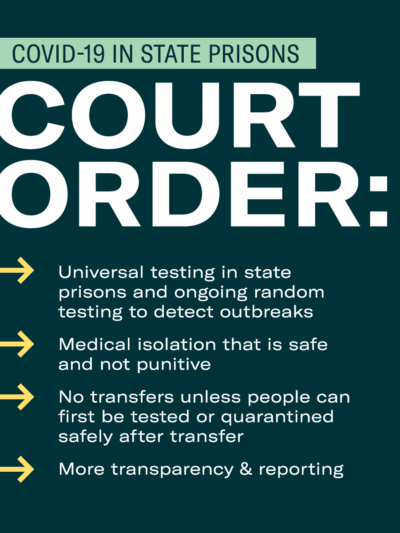
- On June 16, 2020, Wake County Superior Court Judge Rozier granted our motion for an emergency injunction, finding that the conditions inside North Carolina’s state prisons were likely unconstitutional, and ordered state officials to take a series of measures designed to combat the spread of COVID-19 in state prisons and protect medically vulnerable populations.
- On August 17, 2020, we filed a motion notifying the court that the state of North Carolina was not meeting its obligations under the Court’s orders to protect the close to 32,000 people who are incarcerated during the pandemic.
- On February 25, 2021, we reached a landmark settlement resulting in the early release of at least 3,500 people in state custody, making it among the largest prison releases in the country achieved via COVID-19 litigation efforts. Additionally, the settlement required the state to take important measures to mitigate the ongoing threat of COVID-19 in North Carolina’s prisons, including through vaccination and safe testing, cohorting, transfer protocols, as well as monitoring and complaint processes.
“These 3,500 individuals would not have been freed absent the demands of the litigation, the consistent public advocacy by community members, and the scores of brave incarcerated people who have spoken out about the inhumane conditions and treatment they have endured,” said Elizabeth Simpson, attorney and associate director of Emancipate NC.
Documents
- Apr 7, 2020 Emergency Original Petition for Writ Of Mandamus
- Apr 20, 2020 Complaint for Declaratory and Injunctive Relief and Petition for Writ of Mandamus
- Jun 16, 2020 Granting Preliminary Injunction
- Aug 17, 2020 Motion to Enforce
- Sep 11, 2020 Denying Plaintiff’s Motion to Enforce
- Oct 13, 2020 Plaintiffs’ Report for Status Review Hearing
- Oct 21, 2020 Plaintiffs’ Supplemental Submission Following Status Review Hearing
- Oct 27, 2020 Order for Additional Information
- Oct 29, 2020 Supplemental Order for Additional Information
- Nov 6, 2020 Defendants’ Responses To The Court’s Orders For Additional Information
- Nov 13, 2020 Plaintiffs’ Reply To Defendants’ Responses To The Court’s Orders For Additional Information
- Nov 16, 2020 Defendants-Appellants’ Brief Appealing Trial Court’s Preliminary Injunction Order and Subsequent Orders
- Nov 25, 2020 Plaintiff-Appellees’ Motion To Dismiss Appeal
- Nov 30, 2020 Notice of December 4, 2020 Hearing
- Nov 30, 2020 Plaintiffs’ Reply To Defendants’ Responses To The Court’s Orders For Additional Information
- Dec 3, 2020 Plaintiffs’ Submission for December 4, 2020 Status Review Hearing
- Dec 10, 2020 Order Regarding Staff Testing
- Dec 11, 2020 Order Appointing Thomas Maher as Liaison
- Feb 25, 2021 Motion for Stay in Lieu of a Settlement Agreement
- Feb 25, 2021 Consent Order for Stay
Date Filed: Apr 7, 2020
Court: Wake County Superior Court
Affiliate: NC
Download documentDate Filed: Apr 20, 2020
Court: Wake County Superior Court
Affiliate: NC
Download documentDate Filed: Jun 16, 2020
Court: Wake County Superior Court
Affiliate: NC
Download documentDate Filed: Aug 17, 2020
Court: Wake County Superior Court
Affiliate: NC
Download documentDate Filed: Sep 11, 2020
Court: Wake County Superior Court
Affiliate: NC
Download documentDate Filed: Oct 13, 2020
Court: Wake County Superior Court
Affiliate: NC
Download documentDate Filed: Oct 21, 2020
Court: Wake County Superior Court
Affiliate: NC
Download documentDate Filed: Oct 27, 2020
Court: Wake County Superior Court
Affiliate: NC
Download documentDate Filed: Oct 29, 2020
Court: Wake County Superior Court
Affiliate: NC
Download documentDate Filed: Nov 6, 2020
Court: Wake County Superior Court
Affiliate: NC
Download documentDate Filed: Nov 13, 2020
Court: Wake County Superior Court
Affiliate: NC
Download documentDate Filed: Nov 16, 2020
Court: Wake County Superior Court
Affiliate: NC
Download documentDate Filed: Nov 25, 2020
Court: Wake County Superior Court
Affiliate: NC
Download documentDate Filed: Nov 30, 2020
Court: Wake County Superior Court
Affiliate: NC
Download documentDate Filed: Nov 30, 2020
Court: Wake County Superior Court
Affiliate: NC
Download documentDate Filed: Dec 3, 2020
Court: Wake County Superior Court
Affiliate: NC
Download documentDate Filed: Dec 10, 2020
Court: Wake County Superior Court
Affiliate: NC
Download documentDate Filed: Dec 11, 2020
Court: Wake County Superior Court
Affiliate: NC
Download documentDate Filed: Feb 25, 2021
Court: Wake County Superior Court
Affiliate: NC
Download documentDate Filed: Feb 25, 2021
Court: Wake County Superior Court
Affiliate: NC
Download documentNews & Commentary
Incarcerated People are Still Dying of COVID-19, and We’re Still Fighting to Save Them

A Court Ordered NC State Officials to do More to Protect Incarcerated People from COVID-19. They’re Still Fighting It.
Learn More About the Issues in This Case
Related News & Podcasts

Incarcerated People are Still Dying of COVID-19, and We’re Still Fighting to Save Them
A Court Ordered NC State Officials to do More to Protect Incarcerated People from COVID-19. They’re Still Fighting It.
Stay Informed
Sign up to be the first to hear about how to take action.
By completing this form, I agree to receive occasional emails per the terms of the ACLU’s privacy statement.
By completing this form, I agree to receive occasional emails per the terms of the ACLU’s privacy statement.